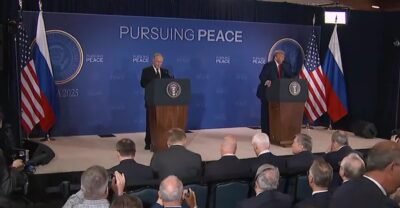
The meeting on August 15, 2025, between U.S. President Donald Trump and Russian President Vladimir Putin in Anchorage, Alaska, was promoted as a summit that could change history. While everyone involved in the summit had their hopes fevered, and the spectacle of the summit eluded any ceasefire or peace agreement in Ukraine, the summit itself was not necessarily a poor diplomatic endeavor, but where the summit became a failure was in chasing symbolism and optics rather than concrete diplomacy and substance. Ultimately, many analysts were left concluding that Putin had successfully walked away the much larger winner.
No Movement on Ukraine
With security, staff, and the world’s media it was more than two hours after the two leaders had their closed-door talks before they came out and proclaimed that there had not been any deals made concerning the longer-term issues of Ukraine.
If anything, Trump said the summit was “productive “and rated it a “10“, but insisted that it was now up to Ukraine and our European allies as to what the next steps should be.
On his side, Putin was resolute: there would not be a withdrawal of Russian forces, there were no compromises on NATO, except perhaps a modest concession of redefining, strengthening and neutralizing Ukraine’s sovereignty.
This was disappointing for the Ukrainians, as every day of inferred intransigence so to speak means further human and economic costs.
The optics: a public relations victory for Putin.
Although the summit yielded no new policies, it gave Putin something even more valuable than that: global legitimacy.
The Kremlin leader enjoyed a red-carpet ceremony in Anchorage.
He was filmed being driven in the U.S. presidential limousine, an honor which elevated him in the eyes of the world.
Although he remains internationally as isolated as ever since his invasion of Ukraine, he now appeared to the world on U.S. soil, as an equal partner at the table.
This imagery will resonate well in Moscow with a domestic audience at home, as well as fit the narrative of Russian strength abroad.
Critics in Washington and other European capitals
Noted that the way that Trump avoided hard demands or sanctions left room for the Kremlin to recover. Wherever he travels, Trump is always criticized for being more focused on the optics than the outcomes, but in this case, he gave his opponent a symbolic victory.
European diplomats worry the U.S. is rolling back its efforts, leaving it to deal with the brunt of the pressure on Russia.
Global Reactions
Kyiv: the Ukrainian government expressed frustration, calling the absence of progress “a deadly pause,” which “draws out the suffering of civilians.”
Europe: leaders had mixed reactions–some expressed delight, while others cautioned that Trump’s softer tone could have unintended consequences for Western solidarity.
Russia: state media heralded the meeting as affirmation that Putin still remains a world leader, despite sanctions and ongoing warfare.
CONCLUSION: More Symbolism than Substance
The Alaska meeting exemplified the limits of Trump’s personal diplomacy. No real agreements were made, leaving the fate of Ukraine unchanged, and Europe uncertain and nervous. For Putin, however, the day certainly was not wasted.
By achieving prestige and visibility, while not conceding any real commitments, he secured what many experts call a “symbolic victory.” As the raging battlefield in Ukraine does not change, in the sphere of world perception, Putin may have taken from Trump more than he cares to give.
About the Author