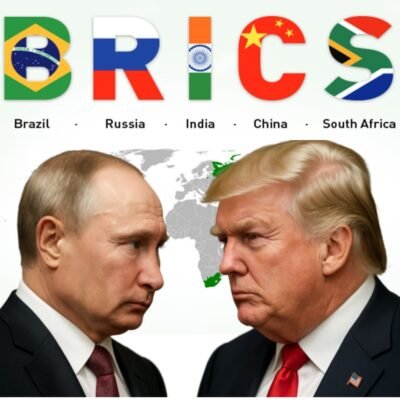
Summary – Trump’s Strategic Communication with Putin and BRICS
Abstract
This article examines the strategic components of President Trump’s public ultimatums to Russian President Putin regarding the Ukraine situation with respect to the implications for BRICS and global economic coalitions where BRICS is weak with continued challenges to the U.S. dollar.
Introduction
In recent statements made by the Trump administration regarding Russia, the rhetoric has grown more and more aggressive, culminating in increasingly shorter deadlines to ceasefire negotiations. The paper showcases some of the strategic communication theory that influenced the statements, and we will briefly engage the broader geopolitical implications.
Strategic Communication Analysis
Main Findings Audience Targeting: Although explicitly directed at Putin, expert analysis indicates the primary intended audience consists of Ukrainian leadership, Western allies, U.S. legislators and NATO partners (Chatham House; Wall Street Journal). The rhetorical scheme is designed to convey a strong and leading America, as opposed to influencing the Russians.
Rhetorical Shift: The shift in Trump’s rhetoric toward Putin has changed a great deal from complimenting Putin as “savvy” or “genius” into more aggressive ultimatums that reflects his frustration with diplomatic failures (The Times; Chatham House; The Economic Times).
Policy Tools and Consequences
The administration has laid out explicit measures related to punishment based on Russian compliance within the established deadline (estimated at around August 7-9):
Direct sanctions against Russia
Secondary tariffs for any country that maintains trade relations with Russia
Congressional sanctions (The Guardian; Reuters; Indiatimes; AP News; The Sun; Chatham House)
Once again, the timing represents an accelerated shift from the previous 50-day deadline and indicates escalating insufficiency of diplomacy (AP News; Reuters; Wall Street Journal).
Professional Assessment and Evaluation
Academic Authors
Chatham House Research: Senior Fellow Keir Giles called the idea of deadlines essentially meaningless saying, “Putin reacts to actions, not the pressure of rhetoric” (New York Post; Chatham House). Having deadlines could allow Moscow more time to act while Ukraine continues to suffer and are looking for help.
Congressional Support: There is a bipartisan congressional support for strong tariffs against Russia, with some calls for tariffs of 500% on Russian exports, meant to improve the executive’s negotiating position (New York Post).
Russian Response
Kremlin officials denouncing renewed sanctions suggest that they have an exemption from more sanctions as the West already has limited economic capacity given current economic policies and societies. Russian leaders issued a warning that ultimatums could exacerbate violence, lead to war and lessen the chance of US-Russian negotiations that establish peace in Ukraine (The Sun; Reuters).
Implications BRICS and Proxy Messaging
Theory Proxy Signaling
The analysis demonstrated a complex broad proxy signaling that clearly saw Putin as a messenger for BRICS nations and Global South nations. The analysis considered that while many BRICS are on the western side of the economic and social paradigm, many of the follow the West in Ukrainian aged economic sanctions regardless of previous ties to Russia:
India and China – have purchased Russian energy at cheaper prices while still in a subscriptions.
Brazil and South Africa – in strategic neutrality and reconciling conflict with both Western and BRICS.
Economic Leverage Mechanisms
The threatened secondary sanctions represent a means of binary choice for neutral countries regarding their international relationships. The unstated premise is that international neutrality or a Russian-friendly policy is likely to be economically expensive through formal or informal trade restrictions by the U.S.
Conclusion
Trump’s public ultimatum to Putin is a multi-and mixed audience communications attempt that signify more than just the state-level bilateral relationship between the U.S. and Russia. The strategy attempts to use economic interdependence to persuade BRICS countries, and other neutral countries, to abandon their strategic ambiguity in the context of the Ukraine conflict. However, expert analysis of the approach suggests limited viability since Putin’s reactions demonstrate responsiveness to actions, rather than public statements, while risking escalation. The communication approach reflects the broader shift in U.S. foreign policy towards economic coercion and alliance pressure, which raises questions about its viability and ultimate effectiveness in achieving stated foreign policy and diplomatic objectives
About the Author