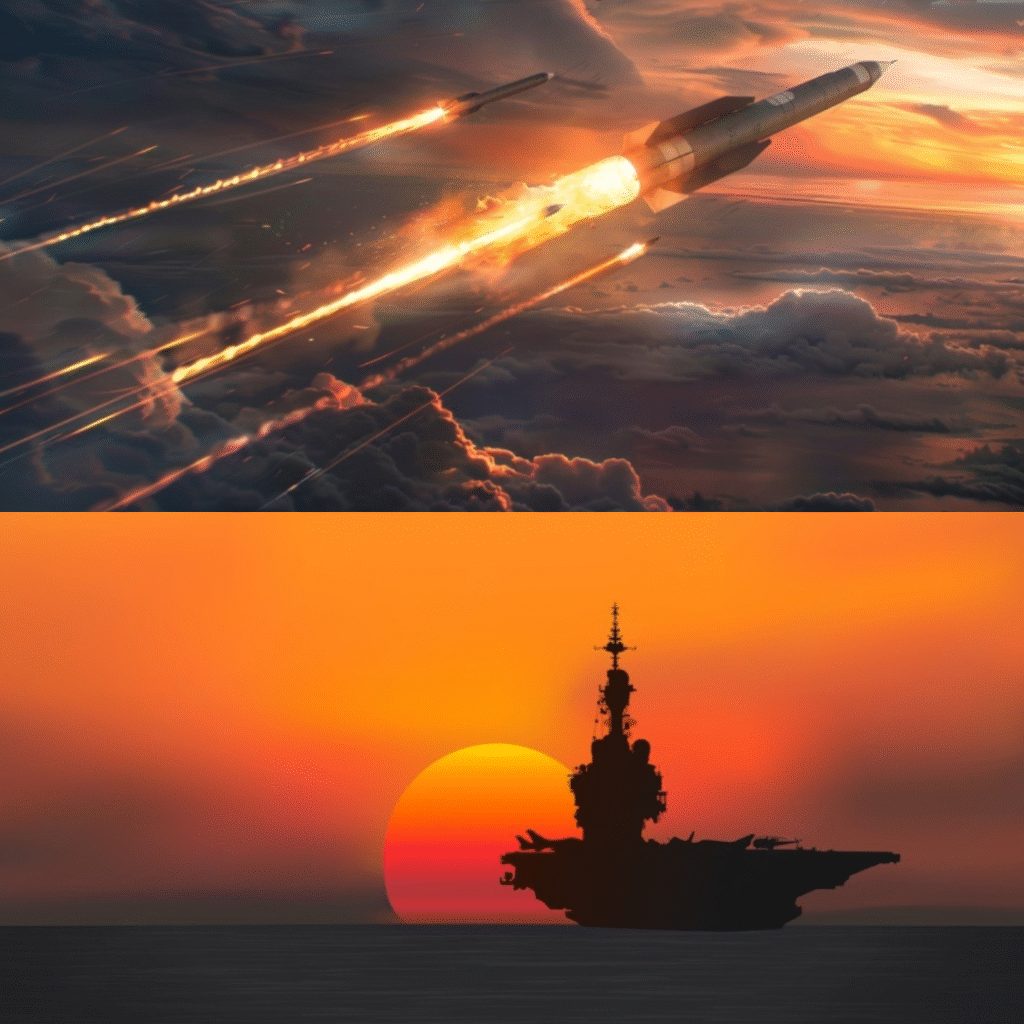
For over one hundred years, the oceans provided the foundation for Geopolitical Strength. From the ability to control trade by the British Navy to the use of naval carrier groups by the USA after WWII, the Blue Water Navy has been the paradigm of Military Power.
Carriers – Mobile Government.
Submarines – Means for Second Strike Survival.
Control at Sea is Equivalent to Control Everywhere.
This long-standing paradigm has entered into a transition state of considerable structural upheaval.
The Disruption of Hypersonic Technology
Hypersonic weapons are essentially a new class of missile that travel in 3 dimensions — through the atmosphere and also perform as a hypersonic “cruise missile” that operates at speeds greater than Mach 5.
Hypersonic weapons are very different than ballistic missiles. The hypersonic glide body and hypersonic cruise missile travel in an unpredictable, low altitude.
This means that hypersonic weapons cut down on the amount of time that a defender has to react. In many cases, the time between launch and intercept will no longer be measured in minutes but in seconds.
Hypersonic weapons also take advantage of the limitations of current radar detection systems. They will hide behind the radar systems that are currently used by air defenders and will present them with multiple targets at the same time.
However, even with these capabilities, carrier battle groups will not be rendered obsolete by hypersonic weapons, but their cost/survivability ratios will become significantly more difficult to maintain and predict.
A naval platform that places 5,000 sailors and the majority of the United States National Pride in a single location will become a more vulnerable and unstable target as hypersonic weapons continue to develop.
A Shift from Sea Control to Denial-Based Warfare
The Role of Naval Power
The role of naval power has changed from one of controlling maritime access to protecting, or surviving, upon an enemy’s ability to deny access to the sea.
Legacy Doctrinal Changes to Emerging Doctrine—Carrier Strike Groups
1. Carrier group power projection used to be the primary means of conducting naval power projection.
2. Dispersed lethality capability, as an emerging doctrine, is the primary means by which a naval power can project its capabilities.
3. Prior to the development of A2/AD, one could dominate in operating Sea Lanes.
4. Under A2/AD policies, naval bases will no longer be used as forward positioning points.
5. In the past, blue-water superiority was the primary requirement needed to achieve maritime success.
6. Presently, Sensor & strike superiority provides a more flexible operational environment for performing maritime operations.
From Maritime Dominance to Denial Dominance
The operational environment has changed from the ocean’s surface to the kill chain: satellites → sensors → networks → weapons.
If a Maritime Fleet does not control its Kill Chain, it is incapacitated.
The Five Pillars of 21st Century Power
The next dominant Power will be a combination of five integrated Systems as opposed to only a Fleet:
1. Hypersonic capabilities
2. Space control
3. Cyber & Electronic Warfare
4. Economic Independence via Industrial/Technological Sovereignty
5. The ability to prevail due to the Depth & Geography of a country that will absorb attacks and inconvenience but will not cause National Paralysis.
Who is best positioned to dominate?
Structural power Reality.
The US is still a dominant naval power; but its naval dominance has been exposed by a concentration doctrine.
Russia has advanced hypersonic technology; however, they have economic and industrial vulnerabilities.
China is the only nation with the combination of mass industrialization, large missile capability, space platform capabilities, and A2/AD geographical denial capabilities.
Iran represents a classical example of how a nation with denial capabilities deals with a nation that has projection capabilities.
India has very promising long-term potential; however, it has yet to be integrated internally.
China is not dominant due to one specific weapon. Rather, it is the entire system of China that creates an unaffordable approach to China.
From Power Projection to Power Denial
The traditional imperial model said, “I can strike you anywhere.”
The contemporary strategic grammar says, “You can’t strike anywhere near me without losing everything.”
This is not an empire or standard empire model; it is a strategic veto.
Management Summary – The Empire of Silence
Navies will always exist; however, navies will not dictate who will ultimately be the superpower.
The next superpower will have capabilities that enable it to dominate through:
hypersonic deterrence
resilience in space
industrial autonomy
invisible warfare
The Age of Oceanic Empires is closing; the emergence of the Empire of Silent Denial is upon us.

Laisser un commentaire