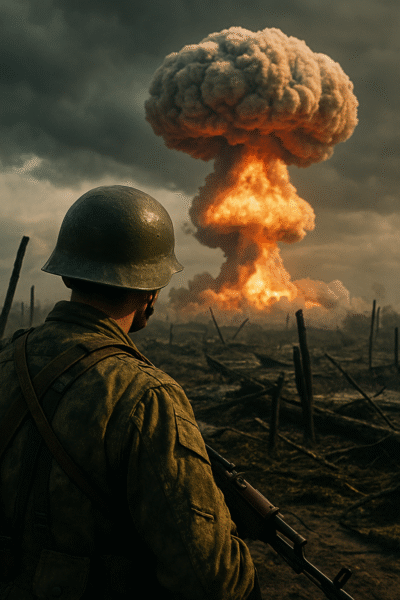
1. Intro: The Antecedent of Global Tensions
The war in Ukraine, a…) nuclear blackout, and the ideological theatre of world leaders such as Vladimir Putin and Donald Trump, has increased anxieties surrounding the health of the international system. While a third world war has yet to be declared on the civilized world, the convergence seen in the militarization of solipsistic states, strategic miscalculations, and the emergence of ideological divides suggest a new era of global conflict. This paper examines the Ukraine war, the players at work in escalating tensions, revivifying nuclear threats, and the theoretical ramifications of a third world war.
2. The Ukraine War, a Proxy Conflict or the Beginning of WW3?
2.1 Nature of the Conflict
Russia’s invasion of Ukraine, in 2022, is an important rupture in post-Cold War geopolitics. Although geographically localized, the ramifications of the war are of global importance. This conflict presents itself as a proxy war between NATO and Russia. The war is in part, the stakes of a bigger ideological and strategic struggle for sovereignty, democracy, and global order.
2.2 Global Ramifications
The war has had ramifications on global markets, in addition to an energy crisis and more military alliances. Western countries sent advanced arms and billions of aid to Ukraine, and the Global South has been more apathetic leading to a tensioned global diplomatic space.
2.3 Is this Characteristic of the World War?
This is technically not a world war, but it can be hybrid; theoretically it contains elements of traditional warfare, while simultaneously exhibiting attributes of hybrid warfare such as cyber warfare, economic warfare, and informational warfare. In short, its effects are global, but it is not a global war.
3. Misconceptions of Putin and Trump
3.1 Vladimir Putin
Putin is often misunderstood by people from the West. His geopolitical perspective is informed by a historical context for Russian greatness, and is also a reaction to what he considers to be NATO expansionism. When he adopts nuclear rhetoric, he typically has a strategic signaling purpose, rather than an intention to launch a nuclear attack.
3.2 Donald Trump
Trump’s more populist and transactional approach to international politics ushered in an understanding different from the normal U.S. foreign policy norms. His support for authoritarian leaders and criticism of NATO resulted in strategic inefficiencies for the U.S. On the other hand, his opinion on the use of nuclear weapons has added to global consequences, even if his comments were not grounded in any knowledge.
4. The Nuclear Dilemma: Existential Threat or Strategic Deterrent?
4.1 The Return of Nuclear Brinkmanship
With Russia’s suspension of arms treaties, the movement of tactical nuclear weapons into Belarus, the specter of nuclear war looms larger than it has in a generation. The U.S. and NATO maintain strategic ambiguity to deter aggression.
4.2 The Risk of Accidental War
Technological errors, cyberattacks, and miscommunication all add potential risks of nuclear wars of accident. Scholars, like Scott Sagan, point out that the probabilities of nuclear war by accident/convention is higher than most policymakers recognize.
5. Is World Wars III an End of Humanity?
5.1 Scenarios on War
A large-scale conflict with nuclear powers will see an extinction of millions of civilians, loss of infrastructure globally, and probably an unsalvageable ecological crisis. Yet there is not a 100 percent certainty that such conflicts would lead to the absolute end of humanity. Some of the models arising from these studies suggest even limited nuclear conflicts may wreck civilizational structure but likely alone would yield the end of humanity.
5.2 Reflections on Ethics and Philosophy
Modern state-based conflicts are common for societies not intimately close to or engaged in conflicts. This occurrence might create a false sense of security and ethical functionalism as NATO and Western allies rely on strategies of nuclear-deterred aggression.
6. Conclusion
While we are not engaged in World War III, we are in a state of systemic global instability. Confusion among world leaders combined with nuclear posturing and incoherent alliances produce a fragile equilibrium. The decisions made in the next few years will determine whether we are able to sustain this equilibrium or whether it will collapse into unrestricted global warfare.
7. Further Reading
Sagan, S. D. (1993). The Limits of Safety: Organizations, Accidents, and Nuclear Weapons.
Ferguson, N. (2023). Doom: The Politics of Catastrophe.
Waltz, K. (1981). The Spread of Nuclear Weapons: More may be Better?
Harari, Y. N. (2022). Essays on war, technology, and global risk.

Laisser un commentaire